Before: 7/6/10:
Waist 31 Inches
Diastasis: 8-10-8

After: 8/24/10
Waist 28 Inches
Diastasis: 4-3.5-3
See more Before & After
Photos here
"Julie Tupler is an Expert on treating diastasis recti"
- Dr. Oz (Oprah & Friends)
TV, Radio, Magazines,
Internet
See full list here
Mickey
BEFORE
Week 1


AFTER
Week 6


(See Mickey Gamble's
story on the left under endorsements)
Joel T.
Before


AFTER


|
|
|
|
The Diastasis Rehab Lose Your Mummy Tummy® program is for women of all ages. It does not matter when or even if you have ever had a baby! We also have a program for baby boomers called Lose Your Boomer Belly™ with the Tupler Technique.® The condition of diastasis recti can affect anyone. Everyone is born with their outermost abdominal muscles separated. As the nervous system matures, the muscles usually close. This occurs when a child is around three years old. However, in 30% of the children it does not close. Even if it did close, the muscles can separate again doing exercises (crunches, pilates 100, yoga backbends, kickboxing) or sports (tennis, golf) that create continuous force and pressure on the connective tissue that joins the two separated muscles.
For pregnant women, the growing uterus creates a diastasis or makes this condition worse. With each subsequent pregnancy, the muscles spread further apart and the connective tissue becomes weaker and weaker. Abdominal trauma leading to the tearing of the connective tissue away from the muscle can cause a ventral hernia and require surgery.
A sure sign of a diastasis is:
The Tupler Technique® program is all about healing the connective tissue.
Closing a diastasis does NOT guarantee it will stay closed. The belly button is a weak spot in the connective tissue. If you use your abdominals incorrectly, and put force on this weak spot, you can re-open your diastasis. So it is crucial to do the other three steps of the program for the rest of your life. This is a life changing program!!
Listen to Kelly Dean's story. She is a physical therapist who became a Tupler Technique® licensee because of how this program changed her life. She has three children..... but had eight pregnancies! She had a very severe diastasis. In her before and after photos you will see that her tatto has moved in the process of closing her diastasis.
The Tupler Technique® Program runs over eighteen weeks. During the first six weeks you will learn the 4- step Tupler Technique® and then in week six of the program, once you have strengthened your transverse muscle, you will learn how to incorporate the Tupler Technique® into any exercise routine. So it is important to do JUST this program during the first six weeks! Walking is fine. You need to wear the splint until your diastasis is closed. Once it is closed you do not need to wear the splint. However, to prevent the diastasis from opening up again, you will need to continue doing the Tupler Technique® exercises.
Incorporating the Tupler Technique® into your workout is called The 5 P’s please…..if you can say it, then you can do it.© This is taught in the Help section of the Diastasis Rehab Lose Your Mummy Tummy® DVD. So until you strengthen your abdominals and know how to use them correctly when working out, we strongly advise you NOT to do any other exercise program or sporting activities during the first six weeks. Until you know how to modify other exercise programs, doing these programs will make your diastasis larger. Walking and running are acceptable activities to do.
There is a very specific protocol of what you need to be doing over the 18 weeks. The first six weeks is the foundation of the program. This is clearly spelled out on a weekly basis in the Tupler Technique® Guidebook. To support you in following this protocol, licensees will see you in week one, end of week three and week six of the program. They teach this program individually or in a group workshop. If you are planning to work with a licensee, it is recommended to watch the Diastasis Rehab Lose Your Mummy Tummy® DVD first before starting to work with them. There is a lot of information to learn, so doing this will make the program work better for you.
The 4-Step Tupler Technique® is:
To support you in getting the full benefit of the program, it is important to have the following items:
The purpose of the six week program is to get you started on the healing process. Depending on the severity of your diastasis it could take you anywhere from six weeks to a year to close your diastasis. However, you will be thrilled to see the healing process starting within three weeks. We recommend that you document your journey by taking before and after photos from the front and the side and writing down the size of your diastasis as well as the size of the circumference of your belly. There is a place in your guidebook to do this. It will motivate you to see the results of your efforts.
You will see that the guidebook goes to 18 weeks. That is because the seated contracting exercises continue to progress from week six to week eighteen. After 18 weeks you then maintain at this level until you close your diastasis. Once you close your diastasis you do not need to wear a splint. However, you will need to continue to do the other three steps of the Tupler Technique® program for the rest of your life! Remember, it is hard to close a diastasis…..easy to open it back up again!
![]() Julie talking to Paul Johansson from |
Looking good has never been more important for men; competition for jobs, advancement and attracting a partner is at an all-time high. As a guy, looking good means being healthy and staying in top shape. But just what does being “in shape” really mean? Most men would quickly say that when it comes to the “abs”, a separated six-pack is the “gold standard.” Yet, what many guys may not realize is that not only can such an effect be difficult to attain, this separation of the abdominal muscles is really the precursor to the “guy gut” or “beer belly.” The Tupler Technique® Program is for men of all ages. We also have a program for baby boomers called Lose Your Boomer Belly™ with the Tupler Technique.®
This “separated six-pack” is known as Diastasis Recti. The Tupler Technique ® is a research-based program for the treatment of diastasis recti, defined as a separation of the outermost abdominal muscles. These muscles are the support system for your back and organs; they are joined together by a piece of connective tissue, with the belly button being the weakest point. The issue? When the muscles separate ,the connective stretches sideways and becomes thinner. The connective tissue, not the muscles, now becomes the support system and thin connective tissue does not do a good job of supporting your back and organs!
Everyone is born with their outermost abdominal muscles separated. As the nervous system matures, the muscles usually close. This occurs when a child is around three years old. However, in 30% of the children it does not close. Even if it did close, the muscles can separate again doing exercises (crunches, pilates 100, yoga backbends, kickboxing) or sports (tennis, golf) that create continuous force and pressure on the connective tissue that joins the two separated muscles.
A diastasis recti puts you at risk for back problems, a protruding belly and belly button, gastrointestinal problems and places strain on the heart. Even worse, any trauma to this connective tissue may tear it away from the muscles exposing your organs, requiring surgery to repair. Closing a diastasis is all about healing the connective tissue. And it is this healing that will address both the negative implications of the “six pack” and eliminate that notorious guy gut.
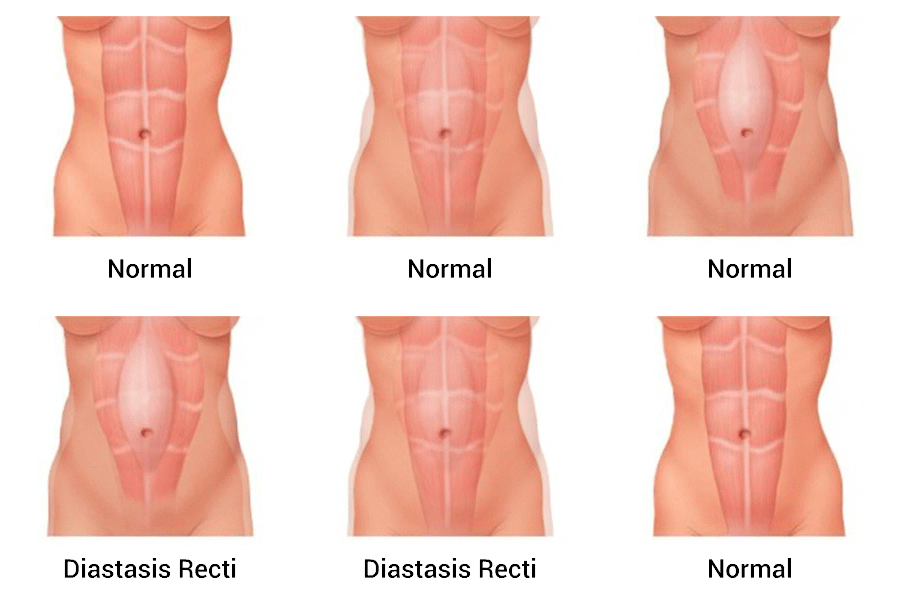
How does this stretching happen? There are several reasons, but a primary one is that many men believe that “crunches” are the sure-fire way to trim abdominals. Crunches – creates intra-abdominal pressure causing this stretching of the connective tissue. Weight gain on the weakened connective tissue then causes the guy gut. A sure sign of a diastasis is a half-football like protrusion when getting up from a back lying position.
The good news is that the Tupler Technique® is not an “all pain” antidote to this problem. Far from it. This easy to learn method, the Tupler Technique® will give you a more challenging workout than you ever had before; and it will also give you toned abs, a strong support system for your back, a smaller waist and a healthier prostate. Ultimately, learning the Technique is a sure-fire strategy to an improved appearance and a healthier body.
The Tupler Technique® Program runs over eighteen weeks. During the first six weeks you will learn the 4- step Tupler Technique® and then in week six of the program, once you have strengthened your transverse muscle, you will learn how to incorporate the Tupler Technique® into any exercise routine. You need to wear the splint until your diastasis is closed. Once it is closed you do not need to wear the splint. However, to prevent the diastasis from opening up again, you will need to continue doing the Tupler Technique® exercises.
Incorporating the Tupler Technique® into your workout is called The 5 P’s please…..if you can say it, then you can do it.© This is taught in the Help Section of the Diastasis Rehab Say Good Bye to Your Gut, Guys ™ DVD. So until you strengthen your abdominals and know how to use them correctly when working out, we strongly advise you NOT to do any other exercise program or sporting activities during the first six weeks. Until you know how to modify other exercise programs, doing these programs will make your diastasis larger. Walking and running are acceptable activities to do.
There is a very specific protocol of what you need to be doing over the 18 weeks. The first six weeks is the foundation of the program. This is clearly spelled out on a weekly basis in the Tupler Technique® Guidebook. To support you in following this protocol, licensees will see you in week one, end of week three and week six of the program. They teach this program individually or in a group workshop. If you are planning to work with a licensee, it is recommended to watch the Diastasis Rehab Say Good Bye to Your Gut, Guys™ DVD first before starting to work with them. There is a lot of information to learn, so doing this will make the program work better for you.
The 4-Step Tupler Technique® is:
To support you in getting the full benefit of the program, it is important to have the following items:
The purpose of the six week program is to get you started on the healing process. Depending on the severity of your diastasis it could take you anywhere from six weeks to a year to close your diastasis. However, you will be thrilled to see the healing process starting within three weeks. We recommend that you document your journey by taking before and after photos from the front and the side and writing down the size of your diastasis as well as the size of the circumference of your belly. There is a place in your guidebook to do this. It will motivate you to see the results of your efforts.
You will see that the guidebook goes to 18 weeks. That is because the seated contracting exercises continue to progress from week six to week eighteen. After 18 weeks you then maintain at this level until you close your diastasis. Once you close your diastasis you do not need to wear a splint. However, you will need to continue to do the other three steps of the Tupler Technique® program for the rest of your life! Remember, it is hard to close a diastasis…..easy to open it back up again!
"Julie,
I want to thank you so much for helping me to overcome my diastasis disorder. I am 64 years old, 6 ft. 1 in height, 185 pounds and have maintained a good physical condition all my life. But I was bothered that in recent years, I could not maintain a relatively flat stomach. I felt that I might be carrying some extra fat in the tummy area that exercise and diet could not remove, so I decided to try smart lipo to remove the fat. Much to my chagrin after the procedure, my stomach pooch was even more pronounced. The doctor who did the procedure referred me to a surgeon who diagnosed me with diastasis. He said he could help me by treating it as a hernia and described the procedure and healing process. I decided not to go that route. I started researching diastasis online and came across Julie Tupler Technique and decided to give it a try. I started wearing the splints on September 19 and also began the exercises the same date. I was totally amazed at the immediate results. My measurements upon starting were a midsection of 38 inches with 35 inches around the belly button area. The diastasis was approximately four fingers in width. I have enclosed photos showing the "before" measurements that were taken by my doctor on September 16. The "after' pictures were taken by the surgeon on October 3. The doctor and her staff were overwhelmed by the drastic change in only six weeks. Six weeks after starting the process, my current measurements are 35 inch midsection and 34 inches around the belly button area. The diastasis has been reduced to approximately one finger in width. Hopefully, in a few weeks, the diastasis will be totally healed. Thanks again for developing your rehab technique for diastasis. I might even try going on the beach again!"
-
Mickey Gamble
"I was diagnosed with a diastasis recti by my GP after I noticed a painless lump in my abdomen and a change in the overall shape of my mid section. I had been attending the gym regularly for the past 8 months and it had turned out that I had injured myself over exerting whilst doing a series of ab exercises. I was told by my GP that there was nothing that could be done to repair the damage and that it was something I would have to live with. After seeing such good results from my training at the gym, I was upset to hear that, so I decided to do a bit of research to find out a bit more about diastasis recti (DR). Julie's name kept appearing and her results seemed excellent so I decided to contact her. I ordered the splint and dvd and had regular skype sessions with her to track my progress. I have been amazed with the results! After following the program for only 6 weeks I had already started to notice the difference - I had not been to the gym and was not doing any exercise other than what Julie's program had prescribed! I have now started going back to the gym and I am incorporating what I have learned with her program in my own training and I am continuing to see improvements - I will certainly never be doing a crunch again and given the results I've had from Julie's program I can honestly say that I will never need to! I can't say thank you enough to Julie for her help and for the quality of the program - thank you!"
- Andrew Jones, UK
Dave E.
BEFORE
Week 1


AFTER
Week 6


AFTER
Week 15


Dave is the winner of 6-Week Online Support Program, Nov. 2012
"Dear Ms Tupler,
I am writing as you suggested in our conversation yesterday about my experience using the Tupler approach to correct my diastasis that resulted from my prostate surgery using the diVinci robot. First I want to thank you for your help, encouragement and explanations of what happened to me. While the surgery went well and fortunately corrected my prostate trouble I was left with a diastasis which was not well explained to me regarding its cause and what to do about it until I received the instructional material from you and spoke with you.
As I reported the diastasis has become considerably smaller with the use of the splint that you send and exercising some care in exercises to avoid and including the correct way to get up from a lying down position. I was also surprised that a lot of what I did following the surgery was exactly wrong including sit-ups, raking leaves and other twisting maneuvers of my body. As an aside, though you didn’t ask, I am a 68 year old male a bit over weight but fairly active and in generally good health. I am starting the suggested exercises and am expecting them to also help. Reviewing the DVD and information booklet was very helpful in explaining what and what not to do.
I would like to encourage you to publish your materials on this topic for men even though the existing information from you is perfectly satisfactory. I’m not sure about marketing your materials but if the urologists involved with this sort of surgery and the subsequent patient recovery had this for their patients I think that it would be of great help. I suppose that this is information that should be well known but until it is pointed out and reviewed it doesn’t get the attention it deserves. I think that lots of times surgeons don’t have the time to explain all this and probably a lot of individuals are left to search the internet until they find your information. Thank you for your help."
Sincerely, P. Truckenbrod Yellville, AR
"Hi Julie,
I hope that all is well. My 18 week incursion into the Tupler Technique will conclude today. I began your program on 11/3/11. As you can see from the photographs, I have been successful in removing the diastasis of the recti muscles of my abdomen. I have also reduced the size of my waist from 36 inches to 34 inches even though my weight has remained stable at 170 pounds. Because of you, I will now have to ask my tailor to take in the waist on all of my pants. Thank you so much for introducing your technique to me and providing me with the video and splint to immerse myself in your program. I appreciate your encouragement. During this process, I have been your advocate to motivate the gentlemen in the locker room in my gym to access your website. I have placed these photographs on photographic paper and plan to show them to the gentlemen in the gym on Monday."
- Joel T.
"I had been diagnosed with a diastasis recti from my Primary years ago and was told the only way to fix it was cosmetic surgery. I am 5’11 and am in reasonably good shape but always had the big belly. Both my parents had big midsections but otherwise fairly proportioned body types so I assumed I was predisposed to my situation.
I was researching ‘diastasis recti’ on the PC and came across the ‘Tupler Technique’. I being the skeptic googled about and decided for all accounts and purposes, I had nothing to lose. I tested myself for diastasis and found I had the ‘football ridge’ down my midsection.
Was I ever surprised that within a week, I indeed was a loser! I lost 3 pounds and an inch across my chest from following the program! This is not a weight loss program yet a way of measuring progress is made thru weekly measurements. As you strengthen your core and essentially keep you insides ‘in’ by wearing the splint as directed, you tend to eat less and work off some of your midsection almost without awareness.
After 6 weeks, the pictures tell the story. I also lost 14 pounds as well. I just followed the ‘6 week support’ program to make sure I was doing everything correct and plan on following it for the entire 18 weeks. I will add I was true to the program and didn’t exercise or change my diet.
Best Wishes and Good Luck if you decide to join the program. In my book it’s a Win, Win."
Dave Edmunds.
The way children are being taught in school to develop their abdominal muscles is negatively affecting their health and well-being!
We all know that developing a strong physical core is crucial. We use our core in virtually everything we do that involves movement— even sitting up in bed! Unfortunately, many children have a weak core because of a diastasis recti.
Diastasis recti is a separation of the outermost abdominal muscles. All babies are born with their muscles separated. Usually, as the nervous system matures, the muscles come closer together. However, in 30% of children, the muscles remain apart.
If a child has separated abdominal muscles, his or her developing spine and organs won’t be supported. Diastasis Recti has even been linked to Central Coordination Disorder (CCD), a condition that results in delayed motor development.
Even if a child’s muscles do close, they can easily separate again if the child performs exercises that put force and pressure on the connective tissue joining the muscles. Crunches, which are taught in grammar school, do exactly that and thus re-open closed muscles or make already separated muscles spread even further apart.
The missing link in strengthening the abdominal muscles is strengthening the inner most abdominal muscle called the transverse abdominis. The Tupler Technique®, a research-based, 4-step program, can heal this condition and prevent it from reoccurring. So, by the conclusion of the program, the diastasis is closed, the children have a stronger core and a better foundation for their future.
To address this challenge, I am producing a DVD called Diastasis Rehab Belly Button Boogie®. This DVD is divided into two parts; Part 1 teaches the 4-step Tupler Technique® as demonstrated by four children, and Part 2 presents a 30- minute program that consists of stretching, strengthening and aerobic activities incorporating the Tupler Technique®. Once the children learn this very simple technique, they will then be able to incorporate it into all their physical activities.
This Program and DVD will be launched March 1, 2013.
DEFINITION OF DIASTASIS RECTIThe word diastasis means separation. So a diastasis recti is a separation of the rectus abdominis or the outermost abdominal muscles. When the muscles separate, the connective tissue that joins them stretches sideways. The more it stretches sideways the thinner and weaker it becomes.
Everyone is born with their muscles separated. Whether it closes depends on the amount of force or pressure on the connective tissue that joins the outermost muscles. If the muscles close, they are always at risk for separating again when there is this continuous force on the connective tissue. Force can be caused by:
The function of the outermost muscles are to support your back and your organs. When the muscles separate this support system is weakened causing low back pain and the "mummy tummy " or “guy gut.” The mummy tummy or guy gut is actually your protruding organs. They are protruding because they are now being supported by a thin (saran wrap-like) piece of connective tissue instead of your muscles if they were together. If there is trauma to the abdominal area and the connective tissue is torn away from the muscle, your organs will come through and a ventral hernia can develop. Surgery will be required. A large diastasis on a pregnant woman will cause the uterus to tilt forward putting the cervix out of alignment. This will make pushing the baby out vaginally much more difficult.
Closing the diastasis will give you a flat belly, a smaller waist and relieve any back problems you are having. It will also make pushing in labor much more effective.
It is NEVER too late to close a diastasis! Closing a diastasis is all about healing the connective tissue. A diastasis can be closed on anyone at anytime! How long it takes depends on the severity of your diastasis and your commitment to the program.
To determine the severity of your diastasis you need to know two things:
I recommend making an eighteen week commitment to the program. You may not entirely close the diastasis, but you will definitely start to see improvement within three weeks and continue to see improvement over the 18 weeks.
Start the program by measuring the diastasis at your belly button, three inches above your belly button and three inches below your belly button. Also measure the circumference of your belly around the belly button. Take these measurements again at six weeks, twelve weeks and then eighteen weeks. I am sure you will be pleasantly surprised! Our Tupler Technique® Guidebook gives a place to input those dates and numbers as well as a chart of all the exercises you need to be doing each day and the progression each week for eighteen weeks.
A diastasis can be checked both during and after pregnancy. The object is to determine how many fingers will fit in the space between the two recti muscles. You also want to determine the condition of the connective tissue. The deeper your fingers will go towards your spine, the weaker the connective tissue. If you feel a pulsing while you are checking, this is a sign of very weak connective tissue. Start with your middle three fingers. You will also want to measure your waist before you start on the program. This measurement will get smaller as the muscles start coming together.
Lie on your back with yourknees bent. Place your fingers in your belly button. Your fingers should be pointing in the direction of your toes.
Relax your abdominal muscles and lift your head. If you are holding your abdominal muscles in as you check it will give you a false reading as this will make the diastasis appear smaller. The muscles will get closer together the higher you lift your head.
To get a more accurate reading, it is important to check yourself when you first start feeling the muscles coming together. You might have to come up and down a few times so you can feel how the muscles work. If you don’t feel the two ridges of the muscles with 3 fingers you may have to put more fingers in. If you see the football- like ridge you should start by using 4 to 5 fingers. You may even have to use 2 hands if your diastasis is very large.
Purpose of splint
The splint is specifically designed to treat diastasis recti, a common condition resulting from pregnancy. The purpose of the splint is to help approximate (pull together) the two halves of the outermost abdominal muscle (recti), making the recommended Tupler Technique® exercises more effective. It also helps heal the weakened connective tissue.
Wear it all the time under your clothes
A splint needs to be worn under your clothing and over a camisole or fitted undergarment to hold it in place better. Our clients get the best results in closing a diastasis when they wear the splint ALL the time. Even when you sleep. Think of it this way. If you broke your leg you would have to wear a cast to heal the broken bones. Your muscles have separated and you need to wear the Diastasis Rehab Splint® to heal the connective tissue to bring the separated muscles together. You are constantly using your core muscles when performing your activities of daily living. One of the steps of the Tupler Technique® program is engaging the core muscles during these activities. So if you are wearing a splint, the starting position of the muscles will be closer together when the muscles are engaged. This then helps speed up the process of closing your diastasis.
How is the splint different from a girdle or control top pantyhose?
The purpose of other girdles or bands is compression or bringing the abdominal muscles back towards the spine. The purpose of the Diastasis Rehab Splint® is to approximate or pull the two halves of the muscles closer together. The splint is worn between the bottom of the rib cage and the top of the hip bones, so each side of the recti can be brought towards the middle. The Tupler Technique® trains your core muscle to do the work of bringing your belly to the spine for a flat tummy. Wearing a girdle lets the girdle do your ab work for you!
Question: Where do I measure to get the correct size for the Diastasis Rehab® splint?
Answer: With your abdominal muscles relaxed, you measure the circumference of your belly with the tape measure over the belly button. If you are closer to the smaller size go with that size.
Question: Can I wear the splint during pregnancy?
Answer: Yes, if you have a large diastasis (4 fingers or larger) it is recommended.
Question: Can I wear the splint during labor?
Answer: If you have a large diastasis it is recommended. Splinting the muscles and keeping them close together while pushing keeps the cervix of the uterus in the proper alignment with the vaginalcanal.
Question: Can I wear the splint when I sleep?
Answer: Yes, sleeping is actually the best time to wear the splint. Your body does not move much while you sleep so it is the perfect time to heal the connective tissue. The more you wear it the faster the connective tissue will heal.
Question: How often should I wear the splint?
Answer: Your abdominals are working with everything you do. It is thus important to engage the transverse muscle during all your activities of daily living and when exercising. Wearing the splint brings the muscles closer together, so the starting position of the muscles are thus closer together when the transverse muscle is engaged. Wearing a splint also puts the weakened connective tissue in a better position for healing. So the more you wear the splint, the faster you will close your diastasis.
Question: Can I close my diastasis by just wearing the splint?
Answer: No. Wearing a splint is just one of the four steps of the Tupler Technique® program. You must do ALL four steps to close your diastasis. The purpose of the splint is to approximate (pull together) the separated muscles. Doing the exercises brings blood flow to the connective tissue helping it to heal. Also when then muscles are closer together it will make the exercises more effective.
Question: How soon after delivery can I wear the splint?
Answer: You can wear a splint within 24 hours of giving birth. If you have had a c-section, it is recommended to wait until the scar is healed (around six weeks) as wearing a splint will pull on the scar.
Question: What happens if the splint becomes too big?
Answer: There are three reasons why the splint may become too big:
So if you are between two sizes, go with the smaller size as the splint will get stretched out and you will become smaller. If the smaller size does not fit initially you can always add a piece of loop Velcro the back piece of Velcro making it longer.
Question: What is the difference between and splint and a girdle or other abdominal binders or body shaping garments?
Answer: The purpose of the splint is approximation (pulling together) the two separated muscles. The purpose of the girdle, abdominal binders and body shaping garments is compression (pulling back) of the abdominal muscles.
Question: Can I wear the girdle, abdominal binder or body shaping garments with the Diastasis Rehab Splint?
Answer: Yes. It is important to wear something under the Diastasis Rehab Splint® to hold it in place better. We recommend a camisole or fitted t shirt. However, with a larger “mummy tummy”I recommend wearing two splints. Put the first one on lower and then the second one on top of that putting the bottom of it about two inches from the top of the lower splint.
Question: The splint is rolling up. Am I doing something wrong?
Answer: No. This is a difficult area to wear something due to the movements in this area. With a larger belly it will roll up easier. So wearing two splints will help keep it in place better. However, when it rolls up, it is a great opportunity to take it off and put it on again and really pull those muscles together. The more you pull them together the better the healing process. So even if it does not roll up on you, you should take it off and put in on again as it does loosen up when wearing it for a while.
Question: When putting on the splint, should I wear it where my diastasis is the largest?
Answer: No. It is only worn at the waist. You have bones on the top of your waist with your ribcage, and bones on the bottom with your pelvis. It is only in the middle where there are no bones should the splint be worn so you can really pull the muscles together. After you strengthen your transverse in week four we recommend to wear the splint and also hold another splint (scarf) when doing the seated exercises. When holding the splint you can hold it at the top (under ribs) for a set, in the middle for a set and then the bottom (around pelvis) for a set.
Question: When I wear the splint my belly protrudes out the bottom. Am I wearing it wrong?
Answer: No. This will happen with the bigger bellies. It is recommended to wear two splints when this happens.
Question: Will it work if I wear it a bit looser?
Answer: It will work but not as well. The closer together the muscles are pulled the better it will work.
Question: Do I have to wear a splint for the diastasis to heal?
Answer: Yes. You must wear a splint to heal the connective tissue. If you do not want to buy mine, please make your own!
Question: What is double splinting?
Answer: The purpose of splinting is to approximate (pull together) the muscles. There are two ways to splint. Wearing a splint and holding another splint (scarf) at the same time while doing the seated and back lying exercises. Double splinting is started in week 4 of the program after the transverse muscle is strengthened.
Question: If I use a splint can I do regular type of abdominal exercises (crunches) to work the outermost abdominals?
Answer: No. Absolutely not. The purpose of the splint is just to pull the muscles together…..not to engage the transverse. If you do regular abdominal exercises (i.e. crunches) where it is impossible to hold the transverse in you will make the diastasis larger.
Question: Is it safe to do abs during pregnancy?
Answer: Click here to see answer by advisory board member, Julie Tupler in Fit Pregnancy
Question: Once I close my diastasis by doing your program can I go back to doing crunches?
Answer: NO. Crunches create a diastasis or make a diastasis larger if you have one. A diastasis is caused by a forward forceful movement on the outermost abdominal muscles (rectus abdominis). When the shoulders come off the floor it is impossible to engage the transverse muscle. If you cannot engage the transverse muscle then it is going forward forcefully making the diastasis larger or creating one. Besides working the muscles in the wrong direction they also work the discs of the spine in the wrong direction. Solution to safely increase the intensity of your abdominal work: When doing the head lifts, bring your feet away from the buttocks. This brings the small of the back off the floor. The higher the small of the back is off the floor, the harder it is to use your abdominals to put it on the floor.
Question: How does one effectively breathe abdominally (belly breathing) while doing the Tupler Technique® seated exercises?
Answer: When doing the seated Tupler Technique® exercises we always start and end with a belly breathe. However, it is not possible to belly breathe while doing the exercises with holding the transverse at 5th floor. You must chest breathe. That is why it is so important to count out loud. This forces you to breathe. If you don’t count out loud you will then put pressure on both your abdominal and pelvic floor muscles.
Question: When I do my seated elevators and transverse contractions, I feel it in my upper back and between my shoulder blades. Am I doing something wrong?
Answer: This is common when you first start doing the exercises. If a muscle is weak it will ask another muscle to help. In this case, it is your shoulders. So when you feel it in your shoulders just relax them. Also make sure your head is not forward when doing the exercises. Think of bringing the chin back as you are doing the exercises. When the head is forward it rounds the shoulders and then you will feel it there while doing the exercises.
Question: Will the seated Tupler Technique® exercises help me with toning my transverse abdominals even if I have a small diastasis? Or is this technique only for correcting a large diastasis?
Answer: The Tupler Technique® is a great exercise for toning even if you do not have a diastasis.
Question: I have a question, or more like a concern. I'm worried that all my hard work with the exercises will be for nothing if I ever move the wrong way. I'm trying to make sure I get out of bed properly, sneeze, and pick up my baby properly. However, I'm not sure with all that I do in my day that it all comes out perfect. Is it really that easy to un-do all the progress from the exercises?
Answer: We use our abdominal muscles with everything we do. A forceful forward movement makes the diastasis larger. However, some forward forceful movements are worse than others. A jack knife and a roll back are the worst and will undo your hard work. So you need to be especially careful not to do these things as they will undo all your hard work.
Question: Can I do pushups and planks if I have a diastasis?
Answer: In a hands and knees position gravity put all the weight of the organs on the already weakened connective tissue. Engaging the muscles in this position will not take the weight off the connective tissue. So planks and pushups should be done against the wall where there is no pressure on the connective tissue and gravity makes it easier to engage the transverse muscle.
Question: When can I start the Tupler Technique® exercises after birth?
Answer: You can start them within 24 hours of giving birth. A great time to do them is while you are feeding the baby. The sooner you start them the faster your diastasis will close.
Question: When can I start in the Tupler Technique® exercises in pregnancy?
Answer: The sooner the better. Wait till the nausea passes. If you start early in your pregnancy the exercises will be easier to do and you will prevent your diastasis from getting larger. You may even make it smaller!
Question: Can I start the Tupler Technique® exercises late in my pregnancy?
Answer: Yes. You can start them late in your pregnancy. It will be harder to do them later in your pregnancy but they will still be helpful.
Question: How do I perform the Tupler Technique® exercises while I exercise on a treadmill, elliptical, rowing machine?
Answer: When you are doing aerobic exercises it is important that you belly breathe to get as much oxygen as possible. Remember to expand and fill the lungs up with air as your bring the muscles forward and then bring the belly back to the spine on the exhale part of the breath. You will be working the transverse if you use the transverse on the exhale part of the breath
Question: Will the Tupler Technique® exercises help with low back pain?
Answer: Yes. One of the functions of the recti muscle is to support the back. When the muscles separate it weakens the support for the back and causes back problems. When you engage the transverse is shortens the recti (outermost muscle) from the middle and makes the diastasis smaller. Also when you engage the transverse muscle you are also working the lumbar multifidus muscle. Working this muscle also helps with low back pain.
Question: How do I take classes that encourage ab work such as crunches?
Answer: Very carefully! You cannot do crunches or any back lying exercises with your shoulders off the floor. You must tell the instructor that you have a diastasis recti and you must do your abdominal work differently.
Question: Can I get pregnant again with a diastasis?
Answer: It is recommended to make your diastasis smaller before getting pregnant again, however, if you do get pregnant and have a diastasis, you need to start doing the exercises right away to keep the diastasis from getting larger. You may even want to wear a splint during your pregnancy.
Question: Once I close my diastasis can I do sit-ups, crunches or the Pilates 100’s?
Answer: No. It is physically impossible to bring the transverse to the spine and hold it there when doing these exercises. Working the core means bringing the transverse to the spine and holding it there. If you can’t do that with any exercise then you will be making the diastasis larger (if you have one) or creating one if you don’t have one.
Question: I get very winded when doing the seated Tupler Technique® exercises. Am I doing something wrong?
Answer: It is very important to count out loud. If you do not count, you will not be breathing and if you are not breathing you will not be using your abdominal muscles correctly. Also, when getting winded, do the exercises at a slower pace.
Question: Can the Tupler Technique® exercises help me during my pregnancy if I know I will be having a c-section. Can I do them after I have a c-section?
Answer: Yes. Stronger abdominal muscles will help with your recovery. Also, strengthening your abdominals during pregnancy will give you the “muscle memory” to make it easier to do the exercises after the birth. After a c-section birth it is important to engage the transverse muscle as a forward forceful pressure on the stitches can undo the stitches. It will be a bit uncomfortable as you will feel a little pulling on the stitches. Once the stitches have healed you will want to mobilize the scar. Tissues are meant to move freely. With a scar it will stick to the underlying layer of tissue. Your job is to pull the top layer away from the layer underneath it.
Question: Is it necessary to space out the exercises throughout the day or can I do them in one daily session?
Answer: We recommend that you space them out during the day initially as the muscle will get fatigued if you do too many at once. Once the muscle is fatigued, you will not be able to do the exercises effectively. Once the muscle is strengthened you can do more each time you do them during the day.
Question: Please advise me on whether the Tupler Technique® can help my prolapsed uterus or if I should discontinue it so I don't make it worse.
Answer: If you have a prolapse, the Tupler Technique® will prevent it from getting worse. When you engage the transverse, it prevents further pulling on the ligaments of your organs. (i.e. uterus, bladder) You must remember to count out loud when you do the exercises. Not counting out loud will negatively affect your pelvic floor.